
Witchcraft
The edge of certainty
Be honest.
How many times have you found yourself having to make a decision where you thought, “I honestly don’t know”. Or entered a complex negotiation uncertain what to say next, or even the precise outcome you’re looking for?
If you’re a seasoned leader you’ve been to the precipice — many times.

Not long ago, I was standing before the executive team of a large human service organisation, slides and remarks prepared, but suddenly inadequate for the moment. The CEO had just revealed to me over a breakfast coffee information that fundamentally altered the strategic landscape we'd been discussing.
"Andrew, should we continue with today’s meeting?" she asked.
In that moment, with 10 minutes before the session start, I felt the familiar sensation—that mixture of adrenaline and clarity that comes when we’ve reached what I call the edge of certainty. I set my prepared remarks aside.
"We need to rethink our approach," I admitted. "But let’s use the first hour to recalibrate — with the group."
That hour produced insights that six weeks of prior analysis and discussion hadn’t — and couldn’t. The agreements that followed became a watershed moment for their organisation's direction.
The best executives and advisors don't merely tolerate this precipice — we cultivate it. We prize it. We walk towards it.
Because we see these moments of productive discomfort as the environment where some of our finest thinking emerges. At the edge we have heightened awareness, creative problem-solving occurs, and we are fully present. All of these are impossible in conditions of complete certainty where execution becomes mechanical.
Question: What’s your equivalent of the precipice, the ‘not knowing’ that brings out the best in you?
Magic without spells
Warning: Distressing content ahead.
In Buenos Aires this week, at an annual global consultants’ meeting, I encountered something unsettling in a downtown gutter—a sacrificed chicken.
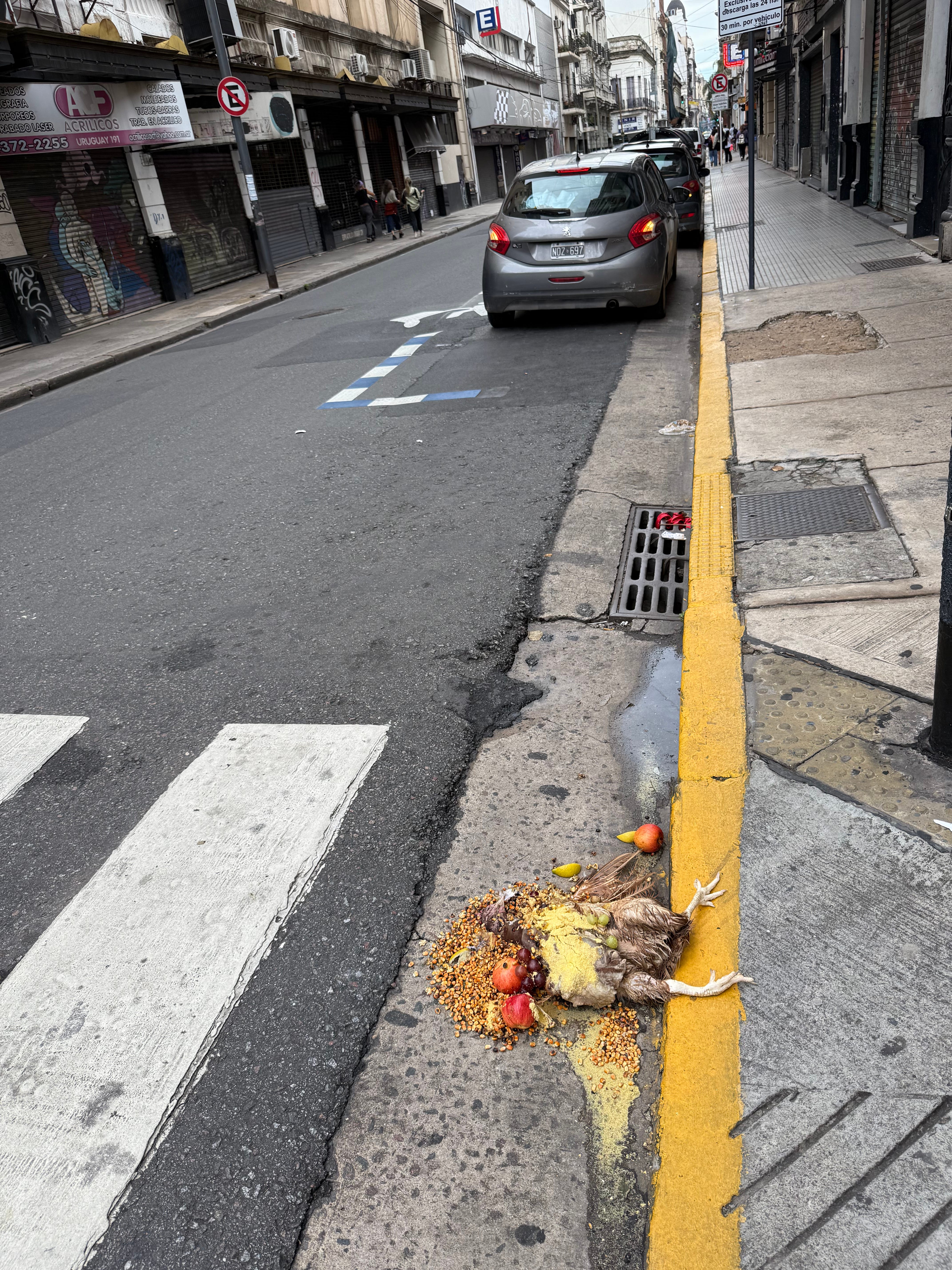
A local told me it was placed as a warning or hex by a local witch. Residents see it as as a potent message to someone nearby, who undoubtedly recognises its significance.
The chicken represents a fundamental truth about human psychology. Somebody believes they can influence the world around them by paying for a ritual. And hiring a specialist to do this. Who then calls upon higher powers.
This dynamic mirrors what we discussed at our gathering of consultants from four continents. For a decade, we've convened annually to explore consulting's cutting edge, emerging global trends, philosophical foundations, and predictive methodologies.
What emerged was this paradox: our clients often approach us seeking "witchcraft" — a magical intervention that transcends ordinary capabilities. Yet our actual value proposition is precisely the opposite.
Consider how our consortium members articulated their distinctive capabilities (can you work out which is mine?):
"I guide family owned businesses to make the best 'life and death' decisions at critical junctures, like deciding to sell, or passing onto the next generation"
"I release the astronomical human potential of technology, so they're exponentially more productive"
"I bring disparate individuals to collective agreement on the best ways they can improve society"
"I can see all of the multiple variables in a complex manufacturing facility and how to leverage these to dramatically improve productivity"
Despite serving entirely different sectors across different countries (UK, Canada, USA, Australia), each articulation contains an element that sounds like alchemy — transforming base elements into strategic gold.
As consultants, though, we’re NOT witches. Our clients can only do what’s in their powers, not ours. If our powers do at times seem to be magical, they’re ultimately human, albeit powerful. Our most valuable contribution is in creating conditions where intrinsic potential already exists.
Our job is to tell them that we’re not shamans or magicians; we’re there to bring out the best in them.
Question: What potential exists in your organisation that you want help to release?
Replaced. Or indispensible?
I sell something called ‘strategy’. And, here is what most of my clients buy when they engage me.
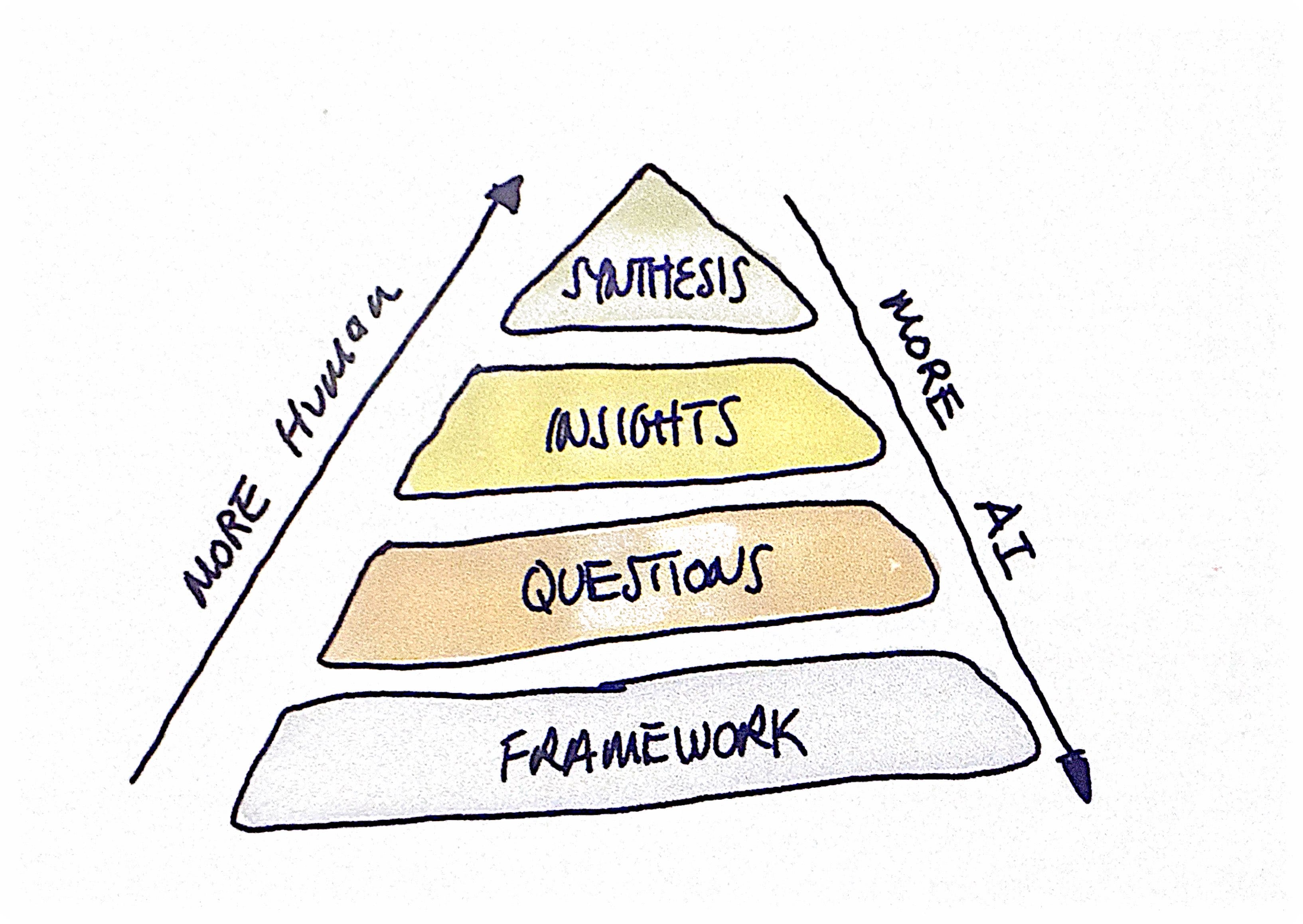
In ascending order, my clients want:
A simple framework: “How we should think about our strategy”
The right questions: “What to ask”
Potent insights: “How to have the conversations, or do the analyses”
An actionable synthesis: “How to bring it together so it guides our future decisions”
As generative AI increasingly permeates decision-making, a crucial question emerges: Where does human judgment — and mine specifically — remain irreplaceable?
So, let’s ask four questions.
Can AI offer a framework for strategic thinking. Yes, it can: any number of strategic frameworks can be ‘programmed’ into an AI system.
Can AI tell us what questions we should ask. Yes, it can posit standard lines of inquiry for an industry, like a regulatory authority, a hospital, a food manufacturing business. But it lacks the contextual intelligence to understand how initial questions should evolve into more valuable lines of inquiry based on organisational nuance.
What about strategic insights — can AI generate these? Yes, but here the limitations are even more pronounced. It won’t be able to content validate these, or organise them in order of significance. Only humans — and, in fact, groups of humans — can do that (for now).
And, lastly, synthesis. Here we reach AI's current boundary. While it can generate multiple synthetic options (Try this: Ask it to provide three alternative approaches), it cannot determine which synthesis will resonate with stakeholders, reflect organisational realities, or truly guide effective decision-making.
So, if you’re developing strategy with the help of AI, consider this pragmatic approach: Apply AI at 80% capacity at the base (Framework) level, then reduce its contribution by approximately 20% at each ascending level. By the time you reach Synthesis, your best humans should be carrying 80% of the cognitive load.
What AI fundamentally cannot replicate is the combined power of trust and speed that a skilled strategist brings. While AI offers computational velocity, it lacks:
Trust-building through personal understanding of unstated concerns
Awareness of organisational history, politics and cultural context
Pattern recognition from diverse strategic experiences
Judgment about when data should be followed versus questioned
The ability to build consensus through interpersonal dynamics
Your task is not choosing between human judgment and artificial intelligence, but in knowing how to deliberately integrate these at each level of the process pyramid.
Question: How can your humans add trust and speed to the capacities that AI gives you in your strategy formulation?
I’m always fascinated by your reaction to what I’ve written, so please drop me a line, a comment, or just a click of the heart. Our meeting here in Buenos Aires is done, so I’ve now got two glorious days to listen to tango music, and eat too much steak and dulce de leche ice-cream.
Look for the seemingly magic around you that is actually human and I’ll see you next Friday, back on Australian soil.
Andrew
I could identify with the magical wishing when internal clients sometimes seek a training solution to address long-standing cultural, systemic and structural issues. The temptation is for the quick fix, without having to do the work or undergo the pain....
Your picture of the precipice is not complete, Andrew. Given the wonderful response that you had to your client, you moved the nearest landmass so close, all you had to to was take a step to continue the journey. Working with the team was the key and while the decision may have seemed memorable, it is, I know, a central part of your work to engage others. Nice job