
Velocity matters
Distribution of speed
Last night I watched the Olympic triathlon and saw New Zealander, Hayden Wilde lead most of the last 10km running stage. He’s almost an Australian, so I was happy to see that.
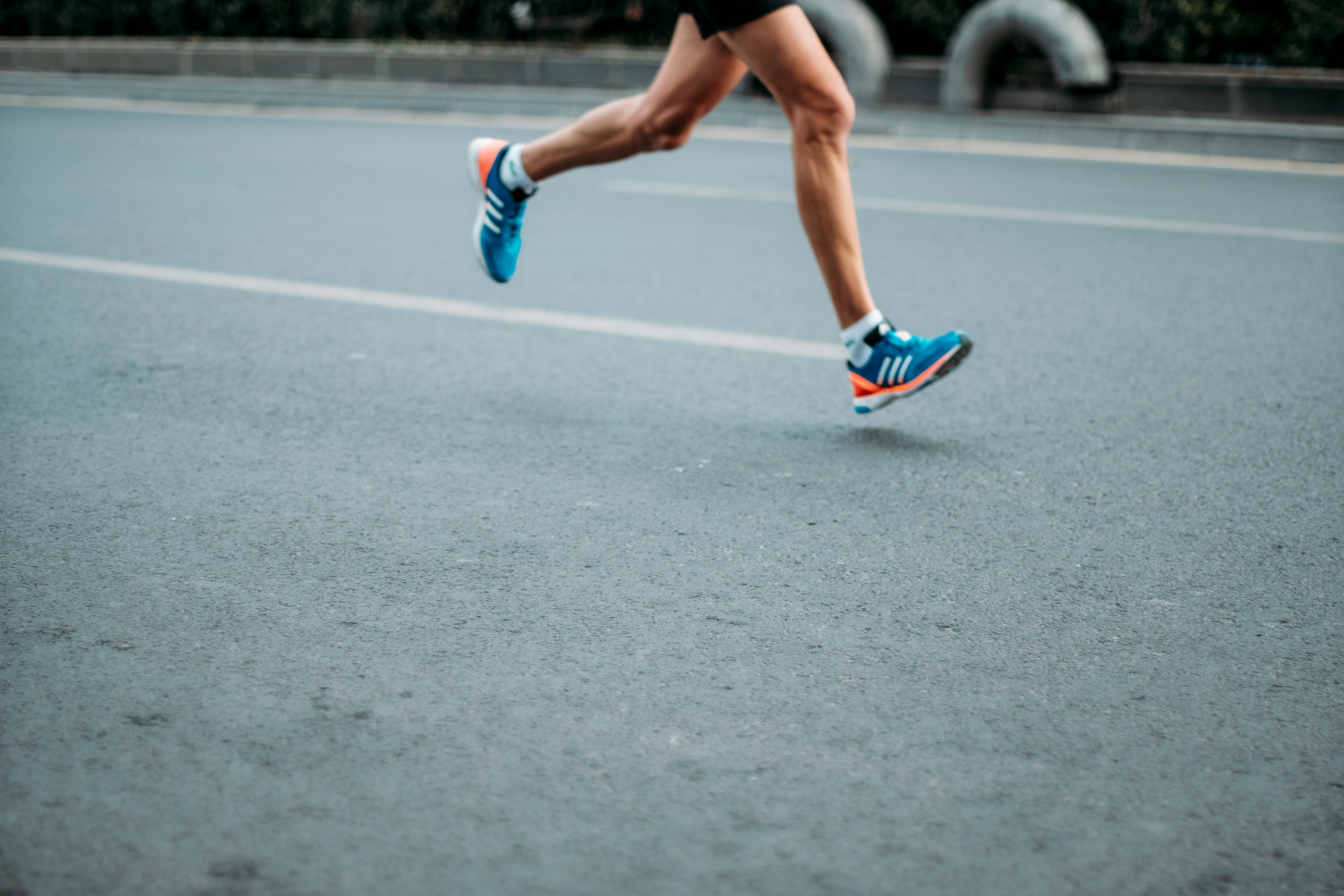
With just a few kilometres to run, he was fully 14 seconds ahead of second placed Alex Yee from Great Britain. At this point, they were one-and-a-half hours into a gruelling race, having swum 1.5kms and biked 40kms.
But, then, with less than one kilometre remaining, something incredible happened.
Yee powered up, and not only caught up to Wilde, but overtook him. Wilde had nothing left to give, and could only look helplessly at his competitor stride ahead to cross the tape ahead of him by just six seconds.
This is the secret of winning that Usain Bolt used to such decisive advantage. It’s not only about running faster. It’s about being able to run fast longer.
The chart here tells the story of Bolt’s (and Yee’s) success. Bolt’s peak speed was 12.2 metres per second. That’s not incredible for Olympians. But what is incredible is that he could sustain it for 30 metres. Not just 10, which is what most of his competitors could do.
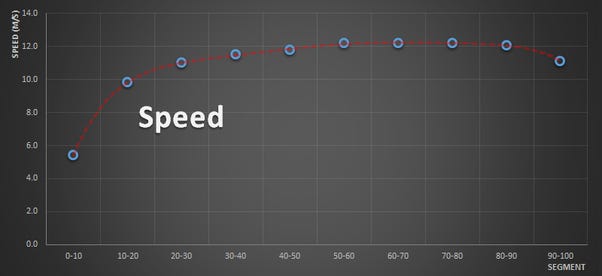
He is fast for a longer duration. This is like Yee, who could maintain a higher speed in the critical last kilometre. Wilde couldn’t, and it cost him the gold.
Question: What is the duration for which you need to up your pace in your business in order to outrun your competitors?
Accelerating returns
Apart from the Olympics, I’ve been preoccupied this week with a marvellous book by a remarkable seer, Ray Kurzweil: “The Singularity is Nearer: When We Merge with AI”.
I know. The title is clickbait, right?
But, Kurzweil (who invented speech synthesis and optical character recognition in the 1960s) is no hack. He argues that we’re just at base camp of the coming even steeper curve of the Law of Accelerating Returns (LOAR).
His evidence? The computer that I bought in my final year of university in 1988 could perform 1700 operations per second. The first smartphone I bought in 2008 expanded that 1000-fold to 1.7 million. Today, my cloud server (well, Google’s) is capable of 170 billion.
And, we’re nowhere near done.
Kurzweil envisions humans increasingly integrating with technology, enhancing our cognitive and physical capabilities, and that by 2029 (yes, only five years), AI will reach and then exceed human-level intelligence in most domains.
The effects?
Here are just three that are, quite honestly, mind-blowing:
Leveraged intellect. The integration of AI with our physiology (brain-computer interfaces) will take our intellectual capacities into the stratosphere. Think about it: already, just using our phones, we have access to ALL human knowledge within seconds. Imagine when this is 1000-times more powerful, contextualised, automated and feels ‘natural’.
Free physical resources. We have already created all the food we need with a few percent of the world’s labour. The next phase of 3D printing will enable us to make everything from buildings to clothing to personalised medical devices at lower and lower cost, eventually driving these down to close to zero.
And, possibly the most radical of all Kurzweil’s predictions: life extension. He calls it ‘longevity escape velocity’ owing to the biotech-AI interface that’s going to use nanotechnologies to add a year to our lives with each year we live. Yes, do the maths: our generation will be the first to potentially encounter immortality.
If you aren’t convinced, don’t let my dot points convince you. Read the book here. I highly recommend it.
Question: Are you (and your business) ready for a dramatic uplift in the already steep curve of the Law of Accelerated Returns?
Stagnant
I often wonder what Vladimir Putin is thinking. Not about Ukraine. But about the Russian economy.
His Central Bank head, Elvira Nabiullina, just put up their base rate by 2% . . . . to 18%. The last time we, in Australia, had a rate that high, we hit our last almighty recession. That was in the late 1980s.
Nabiullina was obliged to say that this is required to “stop the economy overheating”. But we all know that it’s Putin’s war that is killing the Russian economy.
But how exactly?
Nabiullina said it in her (not so) fine print:
All resources in the Russian economy are exhausted.
There is extreme workforce shortage.
Maintenance and modernisation costs are rising due to both inflation and sanctions.
In brief, she said, “Russia is likely facing stagnation or deep recession.”
The point here is about capacity. The Russian economy has none. Read her dot points again: there’s no resource capacity, little people capacity, declining infrastructure capacity.
To grow, you need to invest in all of these. Not only if you’re Russia, but any country and, in fact, any organisation.
Question: What percentage of your revenues are you investing to build capacity in resources, people and infrastructure?
I always love to know your enjoying reading, so you’ll do me a huge favour by clicking the heart. Thanks!
And, outside the Olympics, pay attention to speed. Why it matters. And when it matters if you don’t have it. Another time, we’ll celebrate slowness, but not today.
See you next Friday,
Andrew