
The Work Below the Work
The First Half Hour
She said it at the end of the day, almost as an aside.
“This was remarkable, Andrew. You kept a group of people prone to getting operational, staying strategic. For the whole day.”
Then she added something that surprised even me: she noticed how long I’d spent at the start. Setting up. Before the first agenda item.

That half hour isn’t throat-clearing.
It’s the most important work I do all day.
I think of it as installing the right operating system before anyone opens an application. Not directing the group toward my conclusions. Not railroading the agenda. Something subtler: building the architecture inside which the group will think.
I typically do it through four moves: a story (“let me tell you about a client who . . .”), an invitation (“think of a time when . . .”), a comparison (“the best leadership teams I work with . . .”), and a positive attribution (“I know you’re all people who . . .”).
By the time the real work begins, the group is already regulating its own altitude. My nudges for the rest of the day become almost invisible.
The agenda is not the design. The design is what happens before the agenda.
Question: What would change in your next workshop if you spent as much time designing the opening as you did designing the content?
The Work Nobody Sees
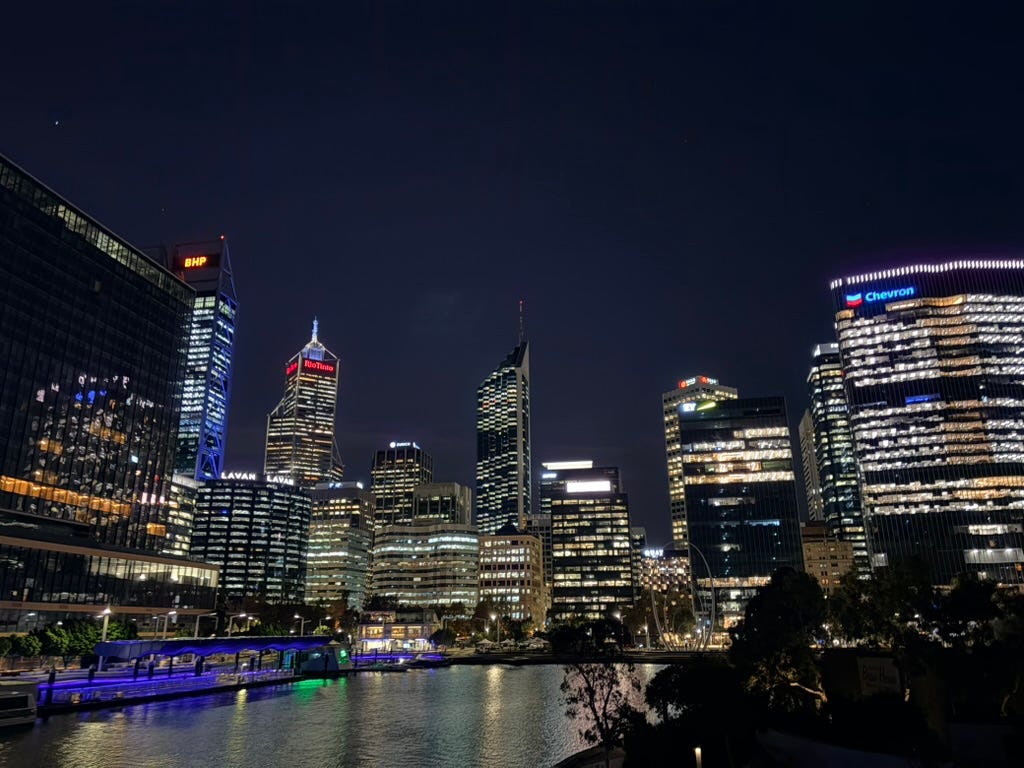
I took the ferry across the Swan River this week. Seven minutes from Elizabeth Quay to South Perth, passing under the elegant arched footbridge that spans the inlet at Barrack Street.
Perth, from the river, looks like a city that has been investing in itself. New precincts. Graceful infrastructure. Visible ambition. And, yes, the logos on the buildings tell us who’s paying for it.
Then I drove through Fremantle. The old traffic bridge — timber, built in 1939 — is being replaced. Not maintained. Replaced. Because maintenance was deferred long enough — coupled with dramatically increased traffic — that the option quietly disappeared.
Stewart Brand’s new book Maintenance: Of Everything makes a deceptively simple argument: civilisation doesn’t run on innovation. It runs on maintenance.
The unglamorous, repetitive, never-finished work of keeping things going. In the best cases, this is designed in from the start; and sufficiently resourced. Defer it, and the necessity accumulates invisibly. Until suddenly the thing breaks, and everything stops.
I see this in organisations. The stakeholder relationship people forgot to tend. The capability never updated. The governance process that outlived its usefulness by a decade. None of it dramatic. All of it costly.
Sometimes it's deferred maintenance. Sometimes the world just outgrew the structure.
Question: What in your organisation is quietly running out of runway?
One Level Up
Doctors call it a presenting complaint: the symptom the patient describes often has little to do with what’s actually wrong. A sore knee turns out to be a hip problem. Fatigue turns out to be something deeper.
Organisations do the same thing.
I’ve come to believe they have a natural hierarchy of four concerns: Purpose, Power, Process, and Resources. When they’re stuck, the presenting problem almost always sits one level below the real one.
Complaining about resources: people, money, facilities? Check your processes: they’re probably wasting what you already have. Arguing about processes? Look for a power problem: unclear authority, competing agendas, exhausted leadership. Fighting over power and influence? The real issue is almost certainly purpose: nobody truly believes in the mission anymore.
The hierarchy matters because organisations almost always try to solve problems at the level they’re described. Which is precisely why they stay stuck.
Question: What problem would be solved if you moved the conversation one level up?
Three segments this week about what happens beneath the visible.
If any of them nudged something loose, I'd love to know. Hit comment, or if you're reading on Substack, the little heart costs nothing and means a lot.
See you next Friday,
Andrew
Love the 30min start, such a critical moment that does a lot of the heavy lifting.
nice insight in the purpose, power, processes and resources question - a lot can lurk below the surface!