
The Hard Stuff
Beyond Strengths-Based
Twenty-five years ago, my mentor Roger would give me a withering look and say softly, with dismay: “I would have thought you could do a lot better than that, Andrew.”
I was gutted. Momentarily. But, then, I improved. Dramatically.
My son’s basketball coach (an imposing figure who demands full-court sprints and push-ups for the smallest infractions) gets nothing but admiration from his players. And, his teams win championships routinely. My mentor today doesn’t hold back either.
The fact is that we live in a strengths-based world.

Participation ribbons. Positive feedback. LinkedIn endorsements. Praise is everywhere and, precisely because of that, it’s losing its value. It’s become the easy option. Giving praise is a path that costs nothing and risks nothing.
What these three people share isn’t harshness, or a desire to punish. It’s a very high compliment, delivered sideways. The hard message only lands because the relationship is built on genuine belief in your capacity. You have to trust them enough to hear it as care. They have to trust you enough to risk saying it.
That mutual trust is rare. Which is why we remember those people for decades.
Question: Who in your life trusts you enough to say the hard thing (and do you trust them enough to hear it)?
The Platform Shift
I was in a strategy session with a digital mental health organisation.
Great people, clear mission, an innovative offering. But they were thinking too small: a defined client group, one product.
So we started pulling at three threads.
Their potential reach was far wider than they’d imagined: employers, universities, member organisations, people across the whole severity scale. The market was filling with untested providers of dubious credibility, which made them — rigorous, evidence-based — suddenly valuable in a different way. And their real expertise wasn’t just delivery. It was knowing how to systematise delivery so others could do it well (and easily, and cheaply).
By the end of our work together, they’d stopped describing themselves as a service provider. They were a platform. A trusted intermediary in a fragmented, noisy market.
Intermediation is one of the oldest business models in the world. Wholesalers have existed since pre-history. The 20th century brought record labels, travel agents, stockbrokers. Today, Uber, Substack, PHNs. All intermediaries. All connecting — and controlling — channels others can’t easily replicate.
Question: If you stopped describing what you do and started describing what (or who) you connect, what would that change?
The Honest Placebo
You know what a placebo is. But do you know when you’re taking one? The whole point is that you don’t.
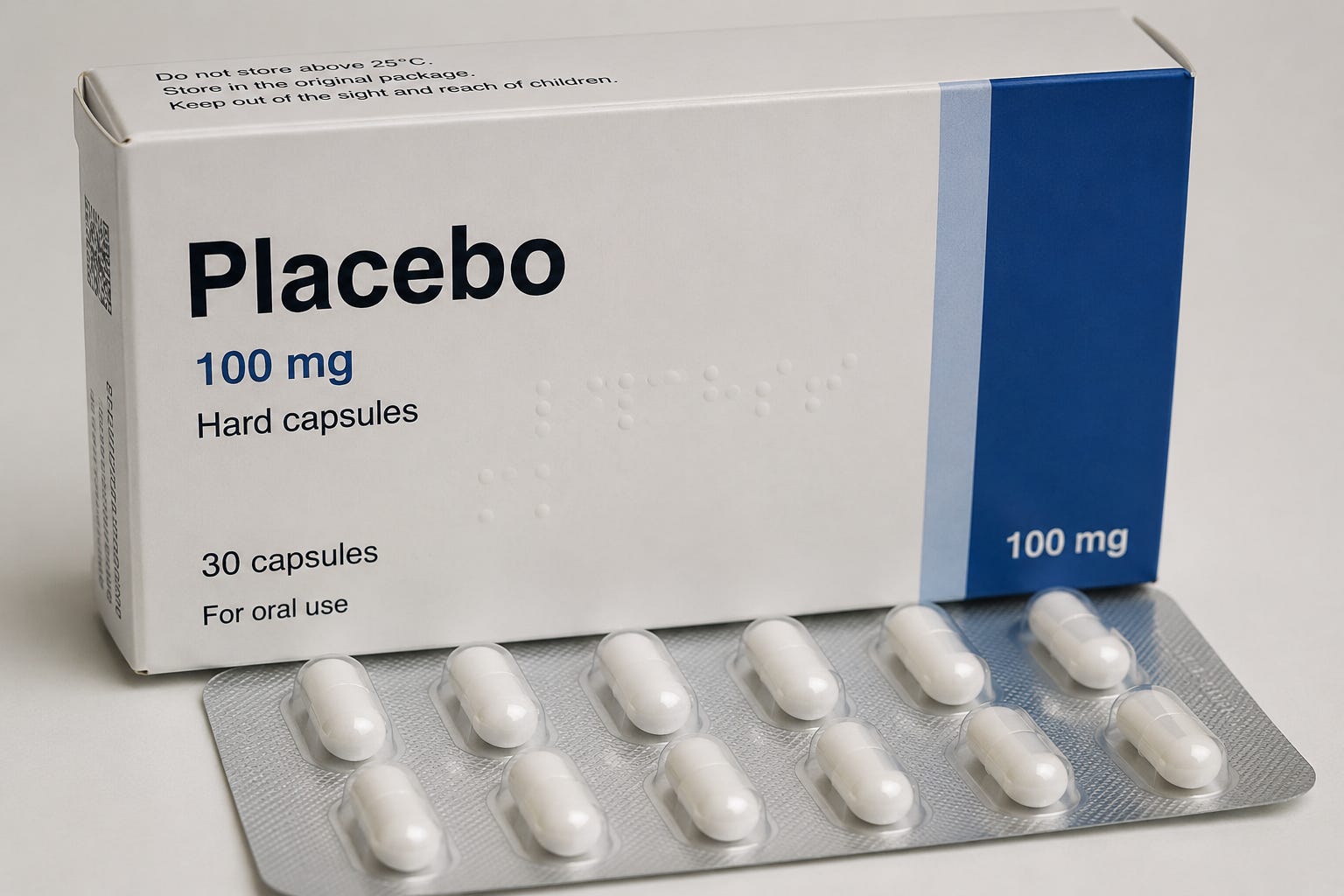
Except if it’s an “honest placebo.”
This is when relief is activated despite the person knowing full well there’s no clinically active ingredient. It may surprise you to learn that they’re used widely: in IBS treatment and cancer fatigue relief for example. Andy Clark, in The Experience Machine, traces the phenomenon to WW2 Italian nurses running low on morphine. In their desperate desire to offer solace and compassion, they used saline. With no reduction in effect.
The mechanism is surprisingly simple. Our unconscious minds automatically create reactions based on superficial signals: people in white coats, authoritative prescriptions, serious-looking packaging.
It’s why restaurants signal quality with white tablecloths. Why airlines give business class passengers warm towels and champagne at boarding. Why steaming, hissing Italian machinery makes a coffee worth $6.
It’s basically ritual, rapport, and congruence: three conditions that confirm an unconscious prediction before a single conscious thought kicks in.
This is where buying decisions are actually made. Not from the spec sheet. Not from the advertising. In the pre-rational experience you design (or neglect to).
Question: Where in your customer’s experience can you confirm (and amplify) their unconscious predictions?
Our segments this week all circle the same quiet idea. That the most valuable things (relationships, business models, customer experience) often work through mechanisms we don’t consciously see.
It’s nearly always worth a look below the surface.
If any of this sparked something, hit the heart. It tells me what’s landing for you.
See you next week,
Andrew