
Substituting Judgement
What AI can and can't do in a strategy process. And why the difference matters.
Can we afford NOT to?
“It’s like the Gold Rush,” the CEO told me. “Everyone’s jumping on. We don’t know what we don’t know.”
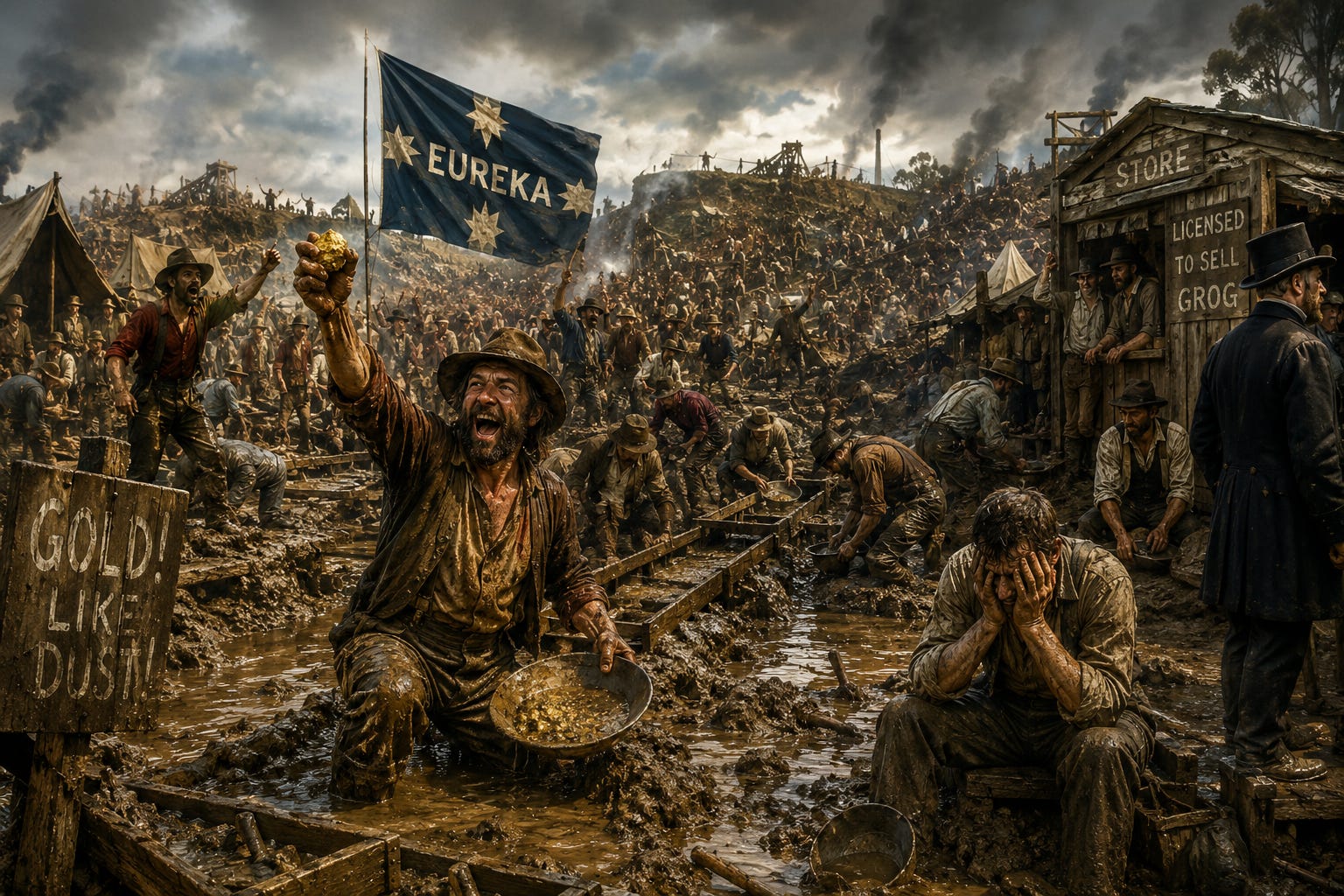
Last month I had a first.
A large organisation — sector leader, serious growth ambitions — ran a competitive bid for strategy work. Their question to every consultancy in the pool: How will you use AI in developing our strategy?
I called the CEO before responding. Not to pitch. To understand how seriously they were asking. His answer was disarmingly honest. They didn’t hold a firm position. They didn’t know how consultants were using AI, or not using it. They barely had it figured out for their own business.
What struck me wasn’t the question itself. It was what it signalled.
Boards are now asking this. If you’re a consultant who hasn’t thought it through, you’re already behind. And if you’re an organisation that hasn’t asked it — of yourselves, or your advisers — maybe now’s the time.
When did you last ask your consultants what role AI is actually playing in their thinking, not just their production?
What AI can do
So, we’ve got the question, from the client. Now, here’s part of the answer: what genuinely can be a ‘Eureka’ moment.
A true story, lightly disguised.
A client leads a significant global initiative. My brief: review the strategy, recommend the highest-potential next moves. Simple enough. Except the review material was dozens of documents and 25 people scattered across the world’s institutions, governments and non-profits.
Before I’d spoken to a single one of them, AI had briefed me on each person — their interest in, and history with, the initiative, the questions worth asking, and a prediction of how they’d answer. That last part still impresses me.
After each cluster of interviews, AI synthesised the emerging themes against my hypotheses: validated, partially supported, not supported.
Not summarised. Synthesised.
There’s a difference, and it matters.
Then came the part I hadn’t anticipated. I asked AI to become each of the major actors (the UN, the World Bank, financial institutions, philanthropists, government ministers) and interrogate my draft strategy from their position. What would they applaud, and support? What would they quietly shelve, or vociferously oppose? And, if the latter, how could I still test and probe that?
This last part was where the true gold lay.
So here are four things AI will do (for me at least) in a strategy process:
Hypothesis sharpening: Am I asking the best questions?
Consultation preparation: Am I testing the right things with the right people?
Conceptual synthesis: Can I assemble the thinking into something coherent?
Perspective stress-testing: Will the people who inherit this strategy actually back it?
Question: Which of those four is your current strategy process weakest on — and would you know if it was?
What AI can’t do. Yet.
And, here’s the second part of my answer.
I heard this recently: ”In any ten-step process, AI can often handle the middle six. Humans should do the bookends”.
I thought, “That makes sense”. I even quoted it to people. Until I tested it against my own process. And, I realised it was rubbish.
In my process, it turns out AI helps with every second step: research, synthesis, stress-testing, perspective checks. The steps between those? Defining the brief. Framing line of inquiry. Designing the consultation. Running the dialogue (with real humans). Constructing the logic of the strategic argument. Landing the concept with the board. Those remain stubbornly, irreducibly human.
The received wisdom imagines AI and humans in a relay race. Hand the baton to AI, take it back at the end.
The reality is closer to a long dialogue, between ‘analysis’ and ‘judgement’. What makes it work isn't AI. It's knowing where AI earns its place, and that's a judgement call too.
So, here’s exactly what I told my client.
“If you engage me, here’s what you actually get. AI does the heavy analytical lifting. I get the framing right, make sure we talk about the real issues in the most productive ways, and make sure where we land has actual utility for you”.
They liked that. And, I do too.
For now, anyway.
Question: What would it mean for your organisation to treat AI as a thinking partner rather than a production tool?
At a rough guess, a third of you reading this develop strategy directly. A third of you, like me, help clients develop it. And, a third of you are curious bystanders.
Regardless of which group you’re in, I’d welcome dialogue on this. Where do you use AI in your strategy process? What works? What doesn't? Where do you see the next frontier?
See you next week,
Andrew
Hi Andrew. I'm using prompts consistent with your thinking such as "...how could my paper be strengthened... to....." But I also really value AI tools which are locked to access internal docs only so I can ask "...review what has previously been documented, approved...", "...taking into account current policy..." etc
I am still a large sponge, trying to comprehend AI, evaluate its value and place in my personal and work life - I was in a supermarket in Prague recently and could not find the lactose free milk, a picture of the entire milk section into chat - response - "bottle with orange top, left side top shelf" - I think I have a long way to go - thanks Andrew you are helping!