
See Further
How big is your frame?
I’m sitting with a CEO and her board. We’ve spent the morning mapping their industry: seventy-plus entities, all shapes and sizes.
Workforce bodies. Research institutes. Unions. Educators. Advocacy groups. Some with a hundred thousand customers. Some serving a single niche.
At some point, someone says: “I think we need to stop writing strategy just about ourselves.”
Yes. Exactly.
Most organisations do. Strategy often defaults to a list of objectives for Org X. More sophisticated ones add a competitor scan: Org X in comparison with others. But the most powerful strategic thinking I encounter positions Org X inside an ecosystem.
Not as the hero. As a participant. One body among many, with its own gravitational pull — and subject to everyone else’s.
I’m writing this at 35,000 feet above the Indian Ocean. Inky black sky in every direction. And, as I do, it occurs to me that this week, four astronauts on board Artemis 2 had a version of this same view — except 250,000 miles further out. Astronaut Victor Glover radioed back from the lunar flyby: “Humans probably have not evolved to see what we’re seeing.”
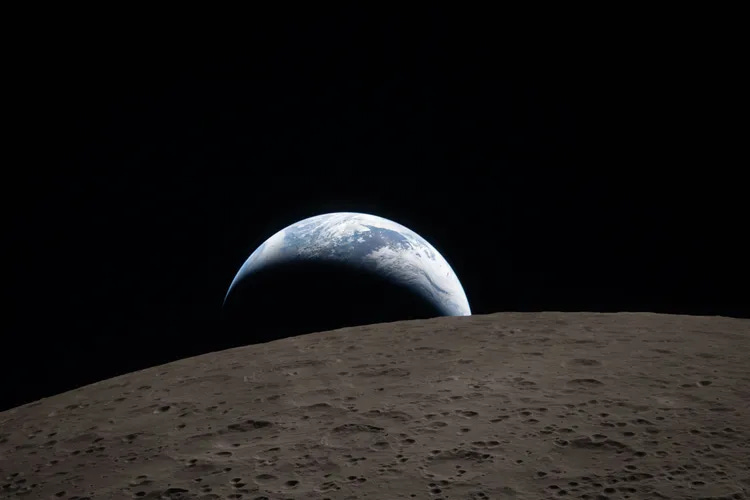
He’s right. And it applies down here too. We haven’t evolved to see ecosystems naturally. We easily see our organisation, our team, our mission. The rest is background.
The CEO I mentioned? Her board now has a picture on the wall. Not an org chart. The ecosystem.
Question: If your strategy positioned you amongst others, how would it change what you prioritised?
Don’t let someone else write your strategy
Last week I wrote about how competitor analysis can quietly neuter your own strategic volition, encouraging reactivity, watching others move first. Whether that’s a regulator, a funder, a competitor, or a major customer pulling a trigger before you do.
The antidote is deceptively simple: ask yourself, “What would I do if X happened?”. Before X happens.
One university did exactly that.
They asked: “What if a major political dispute between China and Australia stopped Chinese students from coming?” It never happened. COVID did instead: same effect, different cause. Enrolments dropped 30%. That university was months ahead of every peer institution in responding, because they’d already done the thinking.
They didn’t predict. They prepared. There’s a profound difference.
I’ve run versions of this with many other teams: posing hypotheticals as thought experiments that felt uncomfortable, even implausible. But the results were the same: the thinking unlocked options that purely reactive planning never would.
Your strategy should be authored by you. Not written for you by events. Or by others.
Question: What 2 - 3 scenarios do you need to think through?
Timing as strategy
There’s a mythologised version of the Virgin Atlantic origin story that circulates endlessly. You might have heard it.
A young Richard Branson cold-calls Boeing. Asks if they have a spare plane. They say yes. He asks what a lease costs. It’s a lot, but Branson starts pocketing money from ticket sales, then pays for fuel and the aircraft lease in arrears. He rinses and repeats. The timing gap creates his margin.
It’s a great story. It’s also not quite right.
He already had Virgin Records: profitable, credible, and financially guaranteeing the whole venture. The deal he structured with Boeing included a one-year return option. If it failed, he handed back the plane. Employment contracts ran one year.
Every exposure was calculated: capped and time-limited.
That wasn’t luck. Nor audacity. It's timing as strategy.
Most leaders launching something new go looking for capital, or a backer: money they own, raise, or borrow. Branson framed a different problem entirely: what’s my exposure, and for how long?
The best strategies I work on consciously phase, sequence, set successive horizons.
One client just adopted three logical 'evolutionary' epochs: 'secure' (lock down fundamentals), 'cultivate' (build capabilities of the future), and 'flourish' (reap rewards of good groundwork - and timing).
Here, the timing is as important as the activities themselves.
Question: How are you using timing as a critical factor in your strategy?
As you read this, I’ve just landed in Portugal and have a few days of adventure amidst the byways and villages of the North, before a week of meetings with a global group of consultants.
We’re each other’s life-support system: if you’d like to signal signs of life to me, please click the heart or leave a comment!
I’ll be back next Friday with observations of Porto, Coimbra and Lisbon that spark useful strategic insights.
Until then, enjoy the view,
Andrew
A terrific 5MSM, thanks for your erudite consistency Andrew, particularly from the other side of the world. Ecosystem mapping – taking the dance floor & balcony metaphor to another level. Artemis 2 – the magnificence of human ingenuity made manifest. Asking “what if” that leads to the action of “what now” – brilliant.
thanks for the insights Andrew. the question that jumps out: if humans haven't yet evolved to see the landscape / ecosystem view, what is preventing them, and how do we evolve, before it is too late? how do we begin to get an expanded sense of our self-interest within and from being a part of a wider ecosystem?